
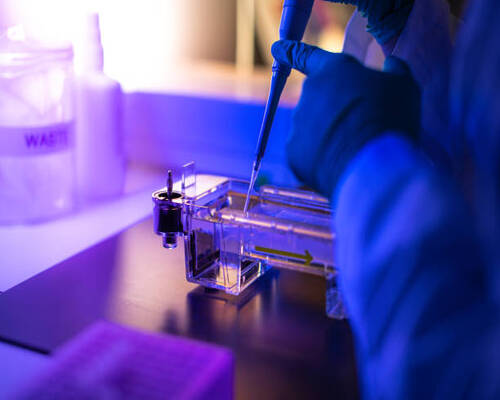
Our agarose delivers exceptional clarity and performance for electrophoresis and nucleic acid separation.Sourced from refined Agar Agar, it forms a strong, low-background gel matrix.Ideal for DNA, RNA, and protein analysis in research and diagnostics.Available in Low EEO and Medium EEO grades to suit diverse lab needs
| Parameters | Low EEO | Low Melting | High gel strength |
| Loss on Drying | ≤ 10 | ≤ 10 | ≤ 10 |
| Clarity | ≤ 3 NTU | ≤ 3 NTU | ≤ 7 NTU |
| Moisture | 10% Max | 10% Max | 10% Max |
| So2 | ≤ 0.10 | ≤ 0.10 | ≤ 0.15 |
| EEO (-mr) | 0.08 - 0.10 | 0.10 | 0.10 - 0.12 |
| Ash | ≤ 1.5 % Max | ≤ 1.5 % Max | ≤ 1.5 % Max |
| Gel Strength | ≥ 1200 gm/cm2 | ≤ 350 gm/cm2 | ≥ 1200 gm/cm2 |
| Gelling Temperature | 35 - 38 deg c | 30 - 32 deg c | 35 - 38 deg c |
| Melting Temperature | 86 - 92 deg c | 65 deg c | 86 - 92 deg c |
| DNAse, RNAse & Protease | N/a | N/a | N/a |
Agarose is most famously used in gel electrophoresis for the separation and analysis of DNA, RNA, and proteins. Its porous matrix allows nucleic acids to migrate based on size, making it fundamental in genetic research and forensic science.
In affinity chromatography, agarose beads are functionalized and used as a solid matrix for the purification of proteins, enzymes, antibodies, and other biomolecules, ensuring high specificity and efficiency.
Agarose is used to create a semi-solid support matrix for growing plant tissues, bacterial colonies, and even mammalian cells. It helps in minimizing shear forces during cell growth and maintaining uniform nutrient diffusion.
Agarose gels are used in immunological techniques to detect and quantify antigens and antibodies. Its transparency and uniformity allow precise interpretation of diffusion patterns and reaction zones.
Agarose can encapsulate cells or bioactive compounds in gel beads or capsules for controlled release or 3D cell culture, used in drug delivery systems and regenerative medicine.
Due to its biocompatibility and gel-forming ability, agarose is used as a scaffold in tissue engineering, supporting the growth and differentiation of various cell types for therapeutic applications.
In molecular biology workflows, agarose is the medium of choice for visualizing restriction enzyme digestion patterns, which are essential in cloning, sequencing, and genotyping.
Agarose is essential in PFGE, a technique used for the separation of very large DNA molecules (over 50 kb), often applied in genomic mapping and epidemiological studies.
Low-melting-point agarose is specifically used in DNA purification from gels, as it can be easily melted and enzymatically digested, allowing for clean recovery of nucleic acids for further use.
Agarose hydrogels serve as models for extracellular matrix, helping scientists study cell migration, signaling pathways, and drug response in a 3D microenvironment.